

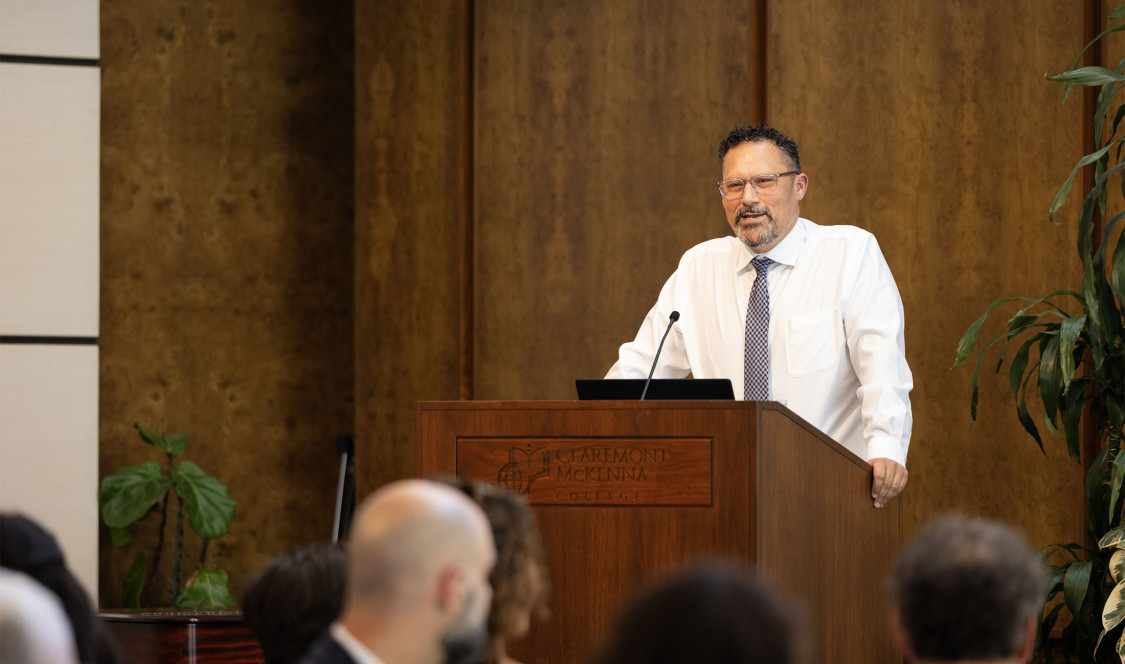
In a special ceremony held in CMC’s Marian Miner Cook Athenaeum on April 14, Professor Nicholas Buccola was installed as the Dr. Jules L. Whitehill Professor of Humanism and Ethics. Members of Buccola’s family—his wife, two children, mother and father, and aunt and uncle—came together with faculty, staff, and students to applaud his accomplishment and listen to his talk, Make America What America Must Become: Loving this Country like James Baldwin.
Also the working title of his forthcoming book, Buccola’s remarks examined a deep-seated societal problem and unflinching efforts to confront it, reflecting the kind of inquiry and engagement that underpinned his selection as the Whitehill Chair.
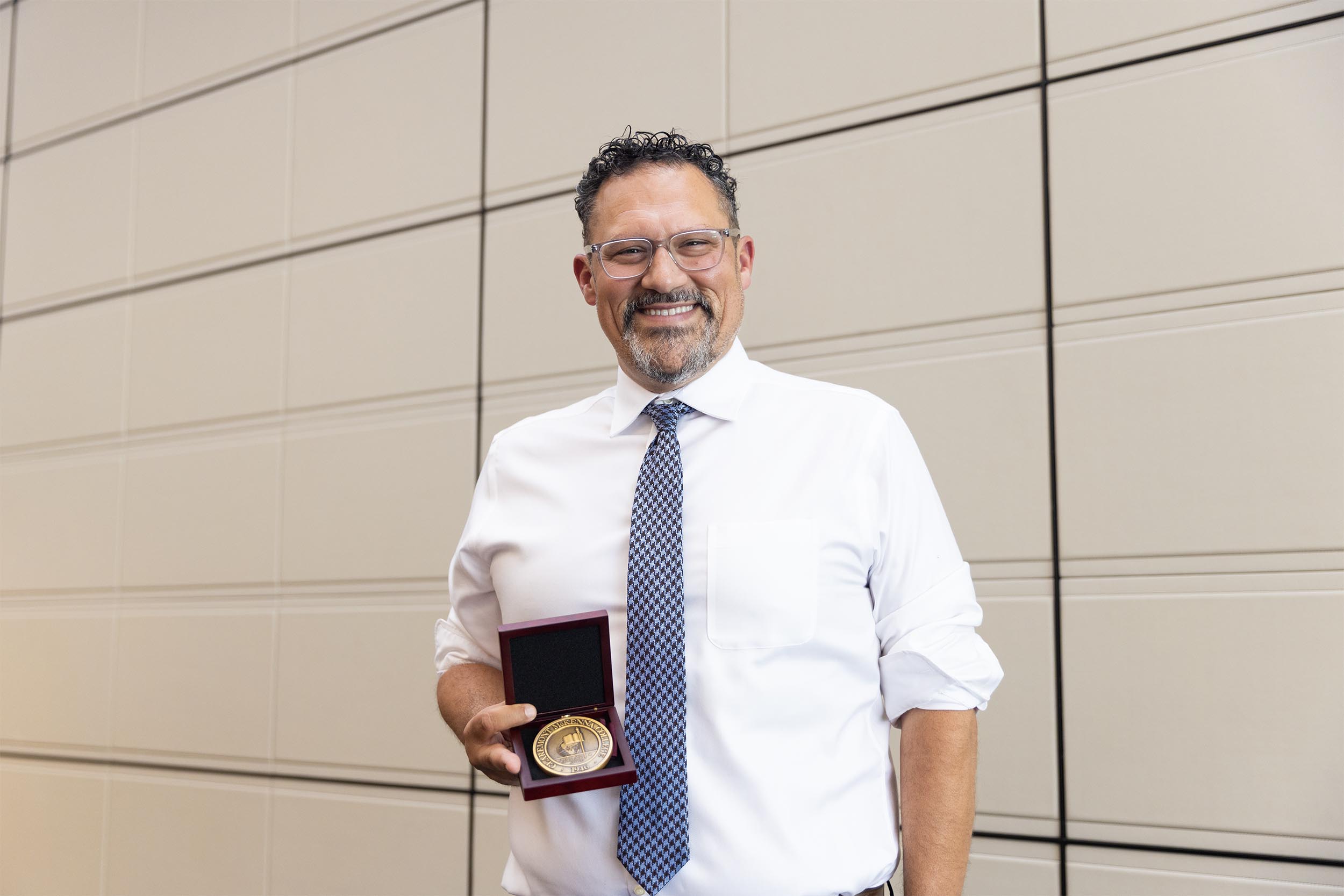
“Known for engaging students as collaborators in exploring complex ethical and political questions, he inspires them to think critically about the moral and civic challenges of our time,” said Heather Antecol P’29, Vice President for Academic Affairs and Dean of Faculty and James G. Boswell Professor of Economics. “His scholarship and teaching exemplify the values of the Whitehill Professorship, embodying humanism, ethical inquiry, and the transformative power of education to guide thoughtful leadership and service.”
Originally established as a scholarship in the 1970s by Dr. Jules L. and Muriel Whitehill in memory of their son, who passed away after returning from service in Vietnam, the family redesignated the fund as a professorship in 2007.
This recognition of Buccola’s achievements came only days after he was honored with the G. David Huntoon Senior Teaching Award, nominated by CMC juniors and seniors for the distinction.
A political philosopher with expertise in American and African American political thought, Buccola joined the CMC faculty in 2023, engaging students in courses such as “What is Freedom?”, “Rebels, Thugs, & Skeptics: 20th-Century American Political Theory,” and “Law, Rights, & Justice.” He currently chairs CMC’s Government Department.
He is the author of several books, including The Fire Is Upon Us: James Baldwin, William F. Buckley Jr., and the Debate over Race in America; The Political Thought of Frederick Douglass: In Pursuit of American Liberty; and, most recently, One Man’s Freedom: Goldwater, King, and the Struggle over an American Ideal.
Setting the stage to discuss his current book project, Make America What America Must Become: Loving this Country like James Baldwin, for which many students contributed research, Buccola brought “two spirits into the room with us, and both of these spirits are going to begin with two words: ‘Make America.’”
What followed was a harrowing montage of videos depicting verbal and physical violence against Black people in the 1960s and at rallies in support of President Donald Trump—the images and attitudes strikingly similar.
“So that’s one ‘Make America,’ for us to have on our minds,” Buccola said at the video’s conclusion.
Another ‘Make America,’ he said, comes from a concept of love as practiced by writer and civil rights activist James Baldwin (1924-1987): A confrontational approach to love as a means of revealing personal and societal delusions—racism, for instance—to foster change.
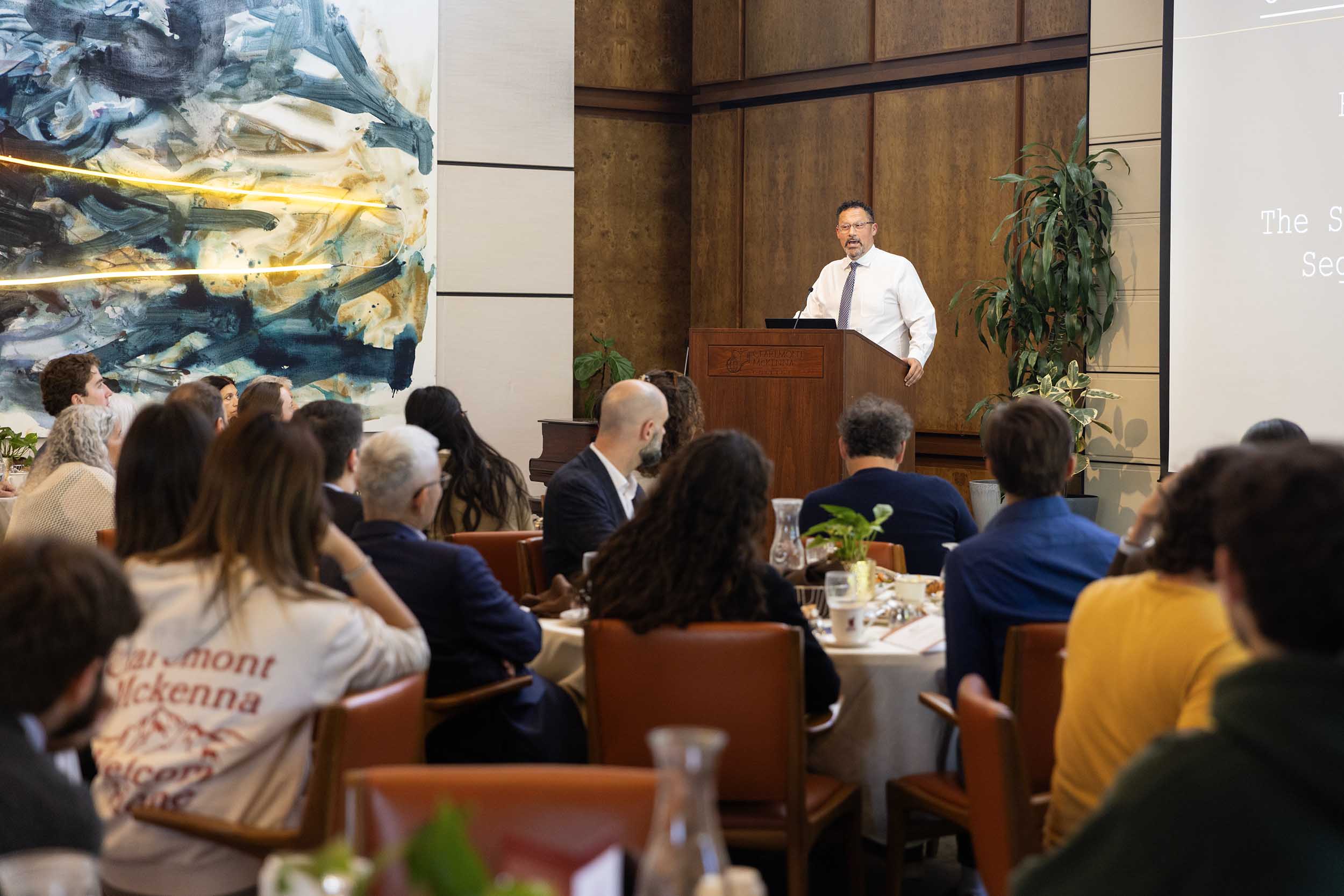
“It's a confrontation with oneself to try to think about the ways in which we've constructed identities that are ultimately rooted in delusion. It's a confrontation with one another in which we try to liberate one another from the delusions under which we live,” Buccola said. “A famous Baldwin line is, ‘If I love you, I have to make you conscious of what you can’t see.’ And Baldwin's love for country is precisely that.”
“What does it look like to love a country in a way that has these ideas of confrontation—confrontation in pursuit of some sort of revelation—what does that look like?” Buccola then posed.
For Baldwin, this often looked like incisive words directed to influential figures of the early 1960s.
For example, in a public debate with conservative journalist James J. Kilpatrick, or the “Salesman for Segregation” per his biographer, Baldwin, Buccola paraphrased, charged, “‘What in your conservatism that includes a commitment, you say, to Christianity, leads you to treat your brothers and sisters the way you're treating them? What in your devotion to American ideals—things like the Declaration of Independence and the Constitution—leads you to treat your fellow citizens the way you are? You may be a conservative, sir, but you're interested in conserving only one thing, and that is your power.’
“That,” said Buccola, “is what loving this country like James Baldwin looks like.”
“My theme in this book is love,” he said. “Love is the idea at the center of Baldwin's thought—his fiction, his nonfiction, his activism, his life. Love is always there as the answer to the perplexing questions that we confront morally and politically.”