

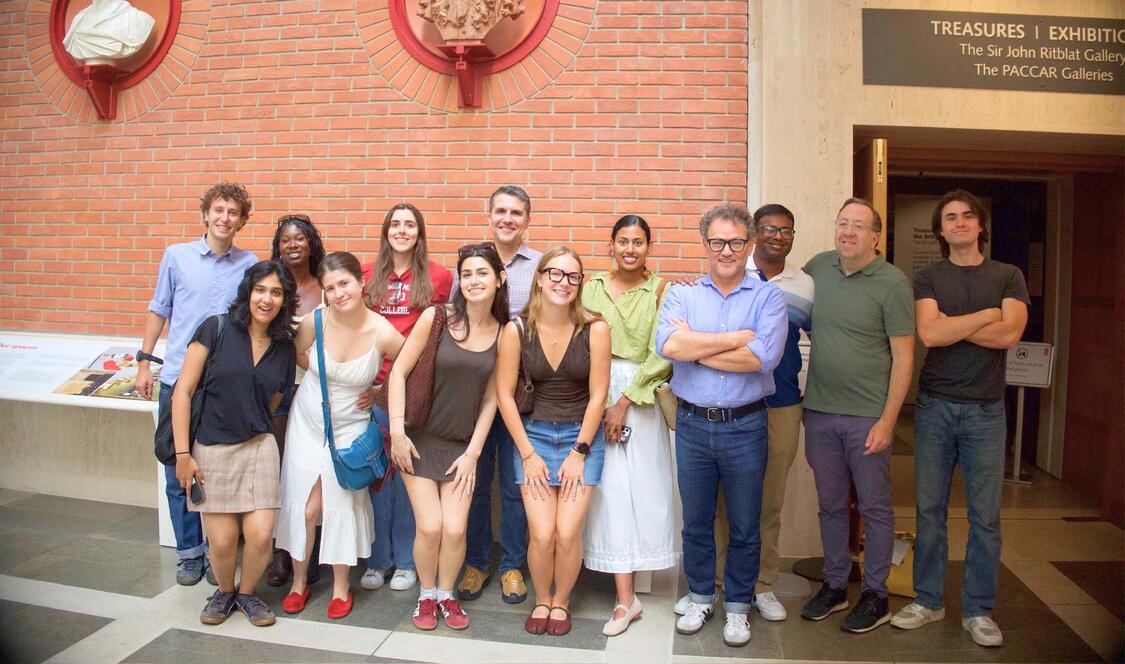
This summer, CMC’s Salvatori Center and The Open Academy (OA) teamed up to take 12 students to London for an exploration of the ideas at the heart of the Declaration of Independence. The five-day conference, “The English Influence on American Liberty,” immersed students in seminal texts and visits to historical sites to illuminate the origins and evolution of liberal democracy.
“Planning this year’s conference around the 250th anniversary of the Declaration seemed perfect because many of the works and ideas that the Americans were developing and building on were English in origin,” said George Thomas, Burnet C. Wohlford Professor of American Political Institutions and Director of the Salvatori Center.
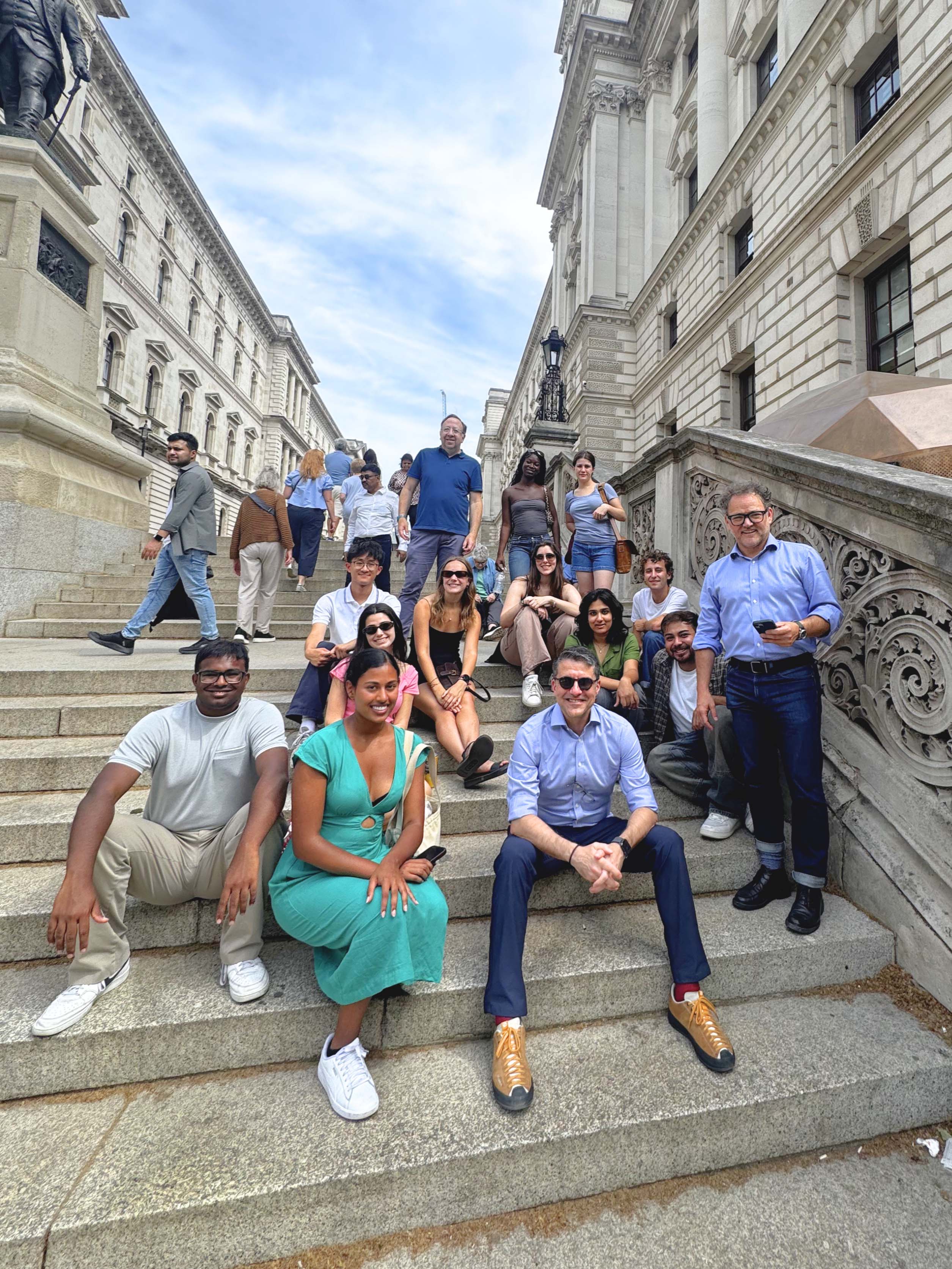
Students participated in faculty-led morning seminars where they discussed works by influential English and American thinkers, including Thomas Hobbes, John Locke, Algernon Sidney, Thomas Jefferson, John Adams, and Mercy Warren Otis. Afternoon excursions to the British Library, Parliament, the Tower of London, the Churchill War Rooms, and the National Portrait Gallery complemented the studious mornings.
The combination of classroom study and related outings offered students a seamless opportunity to visualize historic patterns and make connections: “It takes away a lot of the abstractions,” said Ioannis Evrigenis, Alice Tweed Tuohy Professor of Government and Ethics and Woolley Director of The Open Academy, who helped lead the conference along with Seth Lobis, Associate Professor of Literature.
Greta Long ’28, a Philosophy and Public Affairs major who made the London trip, concurred.
“The most meaningful experience from the conference was the ability to engage with readings during the seminars. The professors were eager to answer all our questions and challenge us on points to deepen our thinking. Additionally, all the outings really helped situate the readings during their time in history,” she said.
Thomas emphasized the value of students gaining a richer understanding that “the world didn’t always look like this.”
“They saw, firsthand, what people were thinking about and wrestling with: How should you organize government? What would be best way to solve real conflicts, especially about but also beyond religion?” he said, drawing a parallel to the differing interpretations of such ideals that persist today, including among the trio of faculty leaders in London.
“Seeing professors disagree, sometimes pretty intensely, about how to read and understand the texts, in a serious fashion and where there’s real respect, was important,” Thomas added.
The inaugural London Conference in 2024, “The Anglo Roots of American Liberty,” was no less infused with Open Academy core principles—freedom of expression, viewpoint diversity, constructive dialogue—making this year’s partnership between the two CMC fixtures a natural and meaningful collaboration.
“The nature of the seminar is very much at the intersection of Salvatori and OA values,” Evrigenis said, adding that “the substantial amount of reading we did served as a common point of reference to supply evidence for the arguments, so it was a very concentrated, deliberate exercise in serious inquiry and serious disagreement with evidence—but as George said, with respect.”
While in England, students had ample opportunities to make connections not only between ideas and momentous points in history, but also with each other and with CMC alumni. Around 40 alumni living and working in London and spanning across generations—including several recent graduates now studying at Cambridge and Oxford—joined faculty and students at a reception, “which was fantastic,” Evrigenis said.
Pending available funding—100% of students’ costs were covered to eliminate any participation barriers—Thomas and Evrigenis both expressed an enthusiastic commitment to future conferences: Rome for republicanism, Athens for democracy, among them.
To fellow and forthcoming students, Long enthusiastically recommended the collaborative conferences.
“Go for it! Being surrounded by such brilliant academics is a privilege, one that you would be remiss to pass up.”