
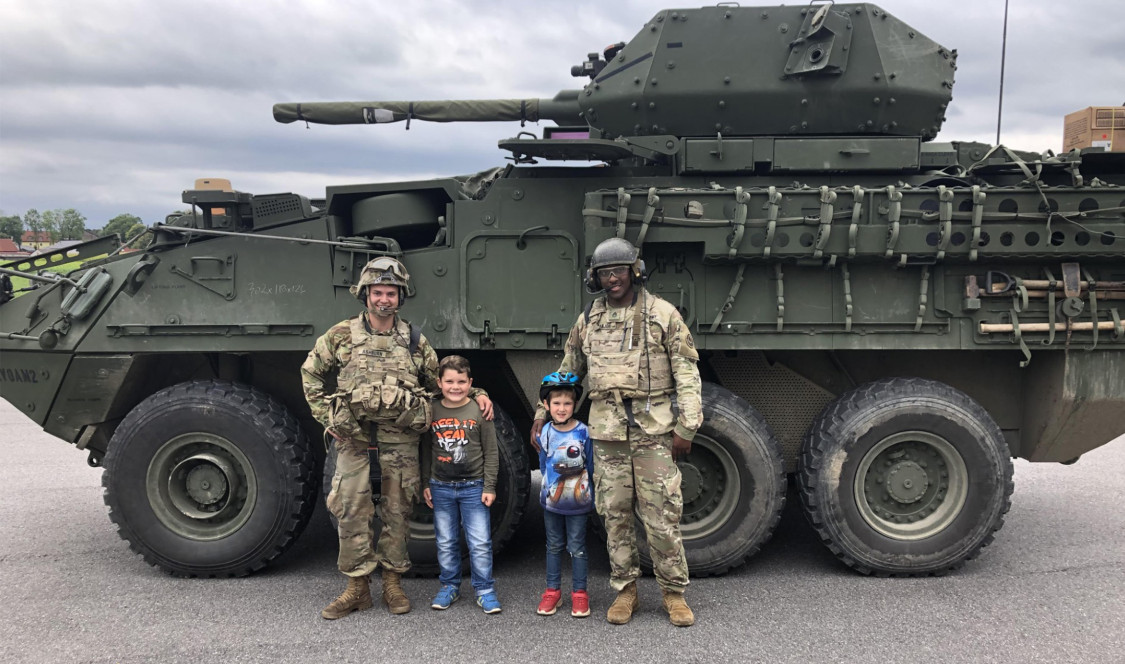
Hunter (Ash) Ashburn ’17 followed his CMC classmate and close friend, John Marshall ’16 into the ROTC program and the Army. They have had parallel careers and have maintained a close friendship ever since freshman year. Having both left active duty, they now work for the same company. Ash commented, “John was my mentor at CMC. He was someone I admired for his leadership qualities. We were suitemates in Boswell and we would have been roommates, but John thought I was too messy.” Ash has always wanted to serve his country, and throughout his military and civilian careers has found ways to give back and help others. As a 22-year-old lieutenant he experienced a wide range of responsibilities and experiences. The Army made him step up and learn quickly. He made mistakes but learned from them.
Ash was fortunate to have a full ROTC scholarship at CMC. The Army paid for his tuition and CMC provided room & board. Upon graduation he won the George C. Marshall award as the #1 cadet in the ROTC Battalion. He did some research before making his branch choice and found that few senior officers seemed happy with their choice. A brand-new Professor of Military Science (PMS) arrived during Ash’s senior year, Major Michael J. Doyle who was an Armor Officer. Ash was pleased to find a senior officer who was consistently smiling and happy. Doyle confirmed he loved his work because it was a chance to lead soldiers, sleep in the mud and “blow things up.” Ash was hooked and chose Armor for his branch. On his first day reporting to Ft. Benning, Georgia he was proud to see a sign that read “Welcome to Ft. Benning: President’s Award for the Best Base in America.”
One of the first field exercises during his Basic Officer Leader’s Course (BOLC) was to learn to drive a tank. Ash was given a vision test: “Can you see out of your left eye? Yes. Can you see out of the right? Yes. You pass!” The students complained they still did not know how to drive a tank. A sergeant asked Ash if he had ever driven a motorcycle. He responded “no,” and the sergeant said “well, it’s just like driving a motorcycle” and left the room. Soon thereafter, Ash found himself in the driver’s seat of an M1A2 Abrams Tank looking through a periscope. Things went smoothly until the sun shined directly into the periscope and he could no longer see where he was driving. He yelled “I can’t see, I can’t see,” so the Tank Commander standing in the hatch above gave him directions. Suddenly, the Commander yelled “Turn right!” but Ash later discovered he had barked “Turn left!” The heavy tank slid down an embankment into a civil war cemetery. The tank bounced a large stone about 30 feet into the air and uncovered a casket (fortunately the casket was not opened or damaged).
Many hours were then spent in interviews with his Company Commander who blasted Ash for poor driving skills, the military police, the CID, and a representative from the EPA. Once the facts were known, he was not found negligent and his Company Commander returned to apologize for his failure to ask the first and most important question every leader should always ask whenever an accident occurs: “was anyone hurt?”
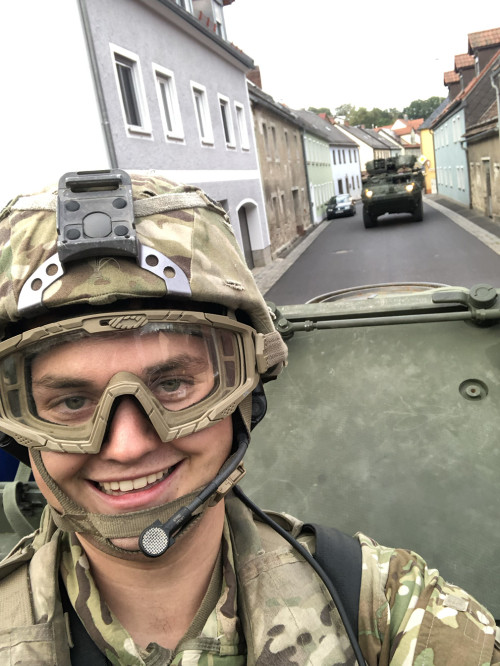
Thinking back, Ash recalls learning an important leadership lesson: it is important for a leader to understand the difference between culpability and responsibility. Mistakes and bad decisions will always happen, but a good leader must examine the circumstances that caused the bad decision and make judgements based on the facts and not the emotions of the moment: why were thousands of lieutenants learning to drive a tank for the first time directly next to a graveyard? Further tank driving was not in Ash’s future, although he acquired the moniker “Grave Digger” with smiles and laughter from his fellow tank officers.
The next stop in Ash’s military career was a posting to the 2d Cavalry Regiment attached to the 7th Army based in Vilseck, Germany. The motto of the unit was “"Toujours Pret"” (Always Ready). The unit was nicknamed “The Dragoons.” They were specialized cavalry units trained equally to fight mounted and dismounted. Ash would spend the next four years in this assignment. Initially he was assigned as the maintenance platoon leader responsible for keeping his Stryker Squadron’s vehicles up and running. These are large vehicles equipped with variants ranging from 30mm to 105mm canons and designed to carry infantrymen into battle. He applied himself and demonstrated his ability to keep his unit operational and ready for battle. After a year of motor pool duty, he gathered the gumption to confront the Squadron Commander late one evening when inspecting the fleet and he asked for a transfer to Scout Platoon Leader. The CO responded “I have been waiting to see when you would apply for the job. Let’s get you transferred.”
Ash was finally able to do what he had wanted to do by becoming an Armor officer: run around in tanks, sleep in the mud and blow things up! He found himself conducting live fire and field readiness exercises all over Germany and throughout Europe: Hungary, Georgia, France, and other Allied countries. Ash applied himself, but he was having fun too. He worked closely with his six squad leaders and a platoon sergeant, overseeing 36 men in the unit. Although lacking in experience, they worked together to accomplish the missions and training exercises they were assigned to accomplish.
On one occasion, the entire unit of 140 of Stryker vehicles were assigned to move to Georgia in southwest Asia to conduct field exercises. This required his vehicles to be loaded onto trains and then boats to traverse the Black Sea. During the operation, the European Union changed the definition of a “weapon” and determined that because the Striker vehicles were equipped with tank cannons (even though there was no ammunition), they were now classified as a weapon and would not be permitted to travel back to Germany by rail. Ash and his first sergeant had to organize two massive convoys of 70 semi-tractor trailers, escorted both by American soldiers and local Military Police in each country with precisely dated diplomatic visas to pass through Romania, Hungary, Austria, and back into Germany. In Ash’s half of the convoy, 55 of the drivers spoke Bulgarian, 15 spoke Czech, and 2 spoke broken English. The drivers wanted to stop at a “party town” just outside of the border to Austria, but Ash knew if they did the drivers would get drunk and his visas would expire preventing him from crossing the border. It took some yelling and screaming to keep the drivers driving, but they kept the trucks moving. Simultaneously, Ash’s contact for the Austrian Military Police escort was no longer responding to his texts. Ash called the American Embassy in Austria, where the voicemail said “the embassy is closed for the weekend. If this is an emergency, press seven.” Ash pressed seven. A gruff major quickly called him back, quite unamused at being called back into work on a Sunday. But a few hours later the MPs arrived, and the convoy crossed the border before the visas expired. The never-ending journey continued, and a minor diplomatic event averted.
These were the trials of a 23- to 26-year-old lieutenant. But there was some free time too and Ash enjoyed skiing in Switzerland and Austria and a sailing excursion off the Greek Islands. He traveled extensively throughout Germany. It was during this time that he reconnected with the funny and daring Tennessee “girl who got away” from the other side of 6th street: Megan Rohn (Pomona ’18), who was pursuing a Fulbright in Lithuania. Ash offered to meet her in Lithuania which would be a “very quick drive in my brand-new BMW;” she giggled and said no but did give him her phone number as a reward for his courage. Then lots of long-distance phone calls ensued, rekindling their relationship. Megan was forced to return to the States early due to Covid, but she met Ash at the Baltimore airport when he returned from Germany. He was enroute to the Captain’s Career Course back at Ft. Benning Georgia and they reunited on December 8th, 2020, a date they still consider to be their anniversary. The two are now happily engaged.
Ash’s belongings were shipped back from Germany by boat and the Army kept promising it would arrive in two weeks, but it took 6 months! So, the pair slept on an inflatable bed, and watched movies on an inflatable couch, as Ash plodded through the Career Course. He was the youngest Captain in the program. After six months together, the couple decided they could live together and wanted to become an official couple. While other Captains left for duty stations around the globe, Ash was fortunate to land a Company Command position right at Ft. Benning training soldiers going through a combined Basic Training and Advanced Individual Training course to become Tankers.
This last assignment turned out to be the most challenging one of his career. In this role Ash oversaw 12 drill sergeants, 30 tankers and 150 male and female trainees undergoing rigorous military induction training. All the trainees were restricted to post and endured arduous 18-hour training days. Ash found himself dealing with behavioral and medical issues of the young 18- and 19-year-olds, many of whom were unprepared for the rigors of military training and discipline. Ash and his team worked hard to ensure no soldier could quit or be left behind.

This new assignment forced Ash to grow up fast. He had much to learn, but he set up a cohesive team and they accomplished a lot of excellent work. He had a very tough Battalion Commander who held him accountable for bringing all soldiers through the program. Ash learned two important lessons that helped him through his final assignment: (1) hold people and himself accountable and (2) saying “thank you” and using other words of praise are free.
Ash decided he could not keep dragging his fiancé, Megan, to military posts around the world and made the decision to leave the Army. Megan opted for a law degree at Emory Law in Atlanta and Ash pursued an MBA at the University of Virgina on the GI Bill. They both bet on making their love endure a three-year, long-distance relationship while both returned to school. Both enjoyed being students again and Ash discovered his was a no nonsense grad program with required attendance and classes taught using the Socratic method that he must prepare for every day. He grasped new tech skills and leaned on fellow veteran students when help was needed.
Ash finally beat John Marshall to the punch and was first to join his current company, Alvarez and Marsal, where both are now employed as consultants. Ash has been able to apply his CMC education (“learning to do”) and Army experience (turning around under-performing Army units) to help his clients navigate financial and operational turbulence, living in Washington D.C. with Megan.
When it comes to his list of Life Lessons Learned, Ash puts forth three that have been instrumental in his military experiences:
- Adopt Extreme Ownership. “If you touch it, you own it,” says Ash. If someone asks you for help, accept responsibility and give it. Take on organizational goals as your own.
- Understand the difference between responsibility and culpability. Take time to look at the circumstances that cause bad decisions and find ways to resolve the root problem; coach your people to understand they are responsible for fixing the mistakes of their subordinates, but you are not holding them culpable for things outside of their control.
- Find ways to give back. Ash’s life and work is fulfilled because he spends his time helping people, whether through professional or personal life.