
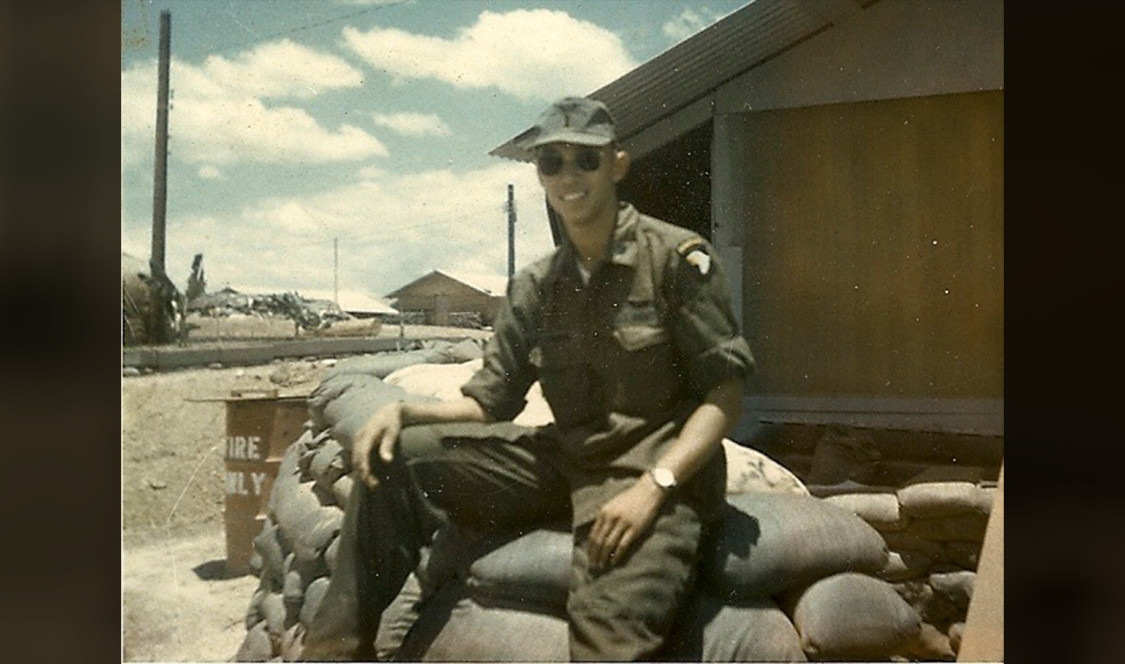
Russ Chung ‘67 has done a lot. He has checked all the boxes at CMC and throughout his military and civilian careers. You would be surprised to find out how much he has done when you first meet this quiet, patient, thoughtful and mild-mannered CMC Alum. But if you ask him about offroad trekking or his Jeep Wrangler you are in for an amazing story. Read on...
Russ Chung came to CMC in 1963 from Berkeley High School following the recommendation of Henry Poy ‘50 who was the scoutmaster of his boy scout troop. Poy was both a mentor and substitute father to Russ as his past away at an early age. Poy brought Russ to CMC and gave him a tour of campus. He became a “Green Weenie” for all 4 years and joined the ROTC program in his freshman year. Like many of his classmates, Russ rightfully believed joining ROTC would give him a deferment from the draft and the 2-year active-duty obligation was not a big deal – at the time. In 1967 when he graduated and was commissioned as a Transportation Corps officer, the war in Vietnam had escalated dramatically and that original belief was now dramatically changed.
Russ found practical employment while at CMC. He spent tax seasons in his Junior and Senior years working for Dr. George Gibbs, CMC’s infamous tax professor (“debits by the windows, credits by the door!”), helping to prepare tax returns for clients of his off-campus business in Claremont. Russ’ job was to take the interview handoff from Dr. Gibbs and fill in the blanks on the tax form. During summer vacation, he drove a truck delivering parts for an auto parts store in Oakland, CA. This experience may have been responsible for the Army’s decision to assign him to the Transportation Corps.
After a couple of weeks of dreary weather at the Ft. Lewis ROTC Summer Camp in the summer between his junior and senior years, Russ awoke one day to clear, sunny skies and was amazed to discover a beautiful view of Mt. Rainier - something even locals rarely got to see. During his Junior year at CMC, Russ decided to apply for the Army’s flight program. He knew the Army required perfect vision, and one eye was not as strong as the other. He had to take his flight physical during ROTC Summer Camp. Hundreds of cadets were being tested and when his turn came, the soldier running the eye exam had him read the same line when covering each eye. Russ memorized the line, passed the exam, and was accepted into the program with 20/20 vision.
Soon after being commissioned as a Second Lieutenant and graduation from CMC, Russ drove his brand new, 1967 Plymouth Belvedere, financed on his military salary across the country to Ft. Eustis, Virginia. This was the first time he had ever been on the East Coast. The Transportation Officer Course lasted 3 months and then in January 1968, it was off to the Officer Rotary Wing Aviator Course (ORWAC). Primary flight training consisted of four months at Fort Wolters, TX, training in OH23 helicopters, a small 3-seat chopper where he learned how to fly, operate the controls and ultimately solo. Russ learned the stressful basics of operating this machine: making max take offs, cross-country navigation, steep approaches, pinnacle landings and takeoffs, landing in confined areas, steep approaches, getting in and out of landing zones and autorotation (i.e., landing without engine power).
He came out of the first phase with 100 hours of flight time and went on to four more months of training in UH-1 helicopters (nicknamed “The Huey,”) at Hunter Army Airfield in Savannah, GA. This was a versatile military helicopter that became a symbol of the Vietnam War. It was the first turbine-powered helicopter used for troop and cargo transport, medical evacuations, aerial attacks, and as a gunship. The controls were remarkably like his previous experience in the OH23, but there were many more gauges to watch out for. This phase of training consisted of instrument flying, formation flying, aerial gunnery familiarization in gunships, and tactical flying. It was the summer of 1968, hot and humid. Russ made repeated practice runs firing the weapons systems. The experience taught him that Huey Gunships were not among his favorite ships to fly.
Upon completion of the Officer Rotary Wing Aviator Course in September 1968, Russ was awarded Army Aviator wings and went on to the month-long Attack Helicopter Course at Hunter Army Airfield. The AH-1G Cobra was a single-engine attack helicopter. This bird featured a gun turret in front that could fire both grenades and mini gun. The wing pylons were equipped with mini guns and rockets. The bird was flown by a pilot sitting in the back and a pilot/gunner, seated below in the front. The gunner was responsible for firing the minigun and grenade launcher in the nose with a 100-degree view to either side of the aircraft and the pilot was responsible for firing rockets or miniguns mounted on the wings. The first Cobras were delivered to the U.S. Army in June 1967. In October 1968, while attending the Attack Helicopter Course, Russ received a promotion to First Lieutenant.
After the one-month Cobra School, Russ went on to the four-month long Aircraft Maintenance Officer Course (AMOC). There he learned about proper maintenance practices, safety procedures, electronic power systems, air conditioning, and maintenance records. Immediately after completing the course, he was deployed to Vietnam in April 1969 and assigned to Delta Company, 158th Aviation Battalion within the 101st Airborne Division. The Division was in the process of becoming an Airmobile Division and his unit was turning in their UH-1 Huey Gunships and replacing them with AH-1 Cobras for attack helicopter support.
Russ became the Maintenance Platoon Leader responsible for signing off on the maintenance of all helicopters and certifying they were ready to fly. He had 40 men in his platoon including 6 NCOs. He was based at Camp Evans in I Corps and lived in plywood huts. A month after arriving in Vietnam, Russ was awakened one night by sirens and a rocket attack. He dashed out of his bunk and into a nearby bunker only to discover he was the only person there. He went outside and found everyone standing around, staring up at parachute flares and outgoing artillery rounds. Russ found his maintenance role to be the right thing for him. He had learned enough about helicopter design, engine systems, hydraulic systems, electrical systems that he could help his very competent NCOs troubleshoot problems.
On one occasion, he was called to inspect a downed helicopter that had been hit by a 122mm rocket. At first glance the helicopter seemed to be fine, but on closer inspection the skin had been pockmarked with hundreds of small shrapnel holes. That helicopter was connected to a sling, and a Chinook Helicopter came in to haul it away. Another time, a Cobra had been refueled and rearmed but was overloaded, did not have enough power to take off and made a “hard landing.” Russ inspected the bird and thinking it was OK, flew it back to base. Upon return, he was alarmed to find three out of five transmission mounts had been broken, and the helicopter was not air-worthy. In October 1969, Russ was promoted to Captain.
Russ spent a year in the maintenance role and decided to extend his tour by six months, garnering an extra free month of vacation and assignment to his unit of choice anywhere in Vietnam where there was a vacancy. He chose to go to Da Nang (China Beach) and the 282nd Assault Helicopter Company, part of the 1st Aviation Brigade. The unit flew UH-1 helicopters with a mission to support the MACV Advisors. Russ became an assault helicopter platoon leader, responsible for ten helicopters, 20 pilots and 20 crew members. Russ admits it was a plush assignment after the 101st. He lived in an air-conditioned room, had access to the Officer’s Club, and frequently went for swims in the ocean at China Beach. His unit’s mission was to resupply and provide transportation to MACV advisors out to their field assignments.
In mid-1970, the Vietnamization program began, and Russ found his unit infused with Vietnamese co-pilots and maintenance personnel. He flew with Vietnamese pilots training them to make helicopter combat assaults and teaching Vietnames maintenance workers proper procedures. Russ had several unusual experiences as Assault Helicopter Platoon Leader. On one occasion Russ was chosen to fly the company’s Command-and-Control Helicopter for a practice helicopter combat assault with Vietnamese pilots. He describes the experience as “feeling like a teenager whose father had allowed him to take the family car out on a date.”
In November 1970, after an 18-month tour, Russ received orders to the Aviation Systems Command in St. Louis, Missouri. This facility was the headquarters for all logistics coordination for Army aviation. The building was in downtown St. Louis, MO, housed about 100 Army officers and 3,000 civil servants responsible for engineering, procurement, and contract administration of everything having to do with Army Aviation. This was quite a transition for Russ who had only 10 months left on his active-duty obligation. His boss talked him into extending as “voluntary indefinite.” He remained in St. Louis for the next four years.
In 1974 Russ returned to Ft. Eustis, VA for the 9-month Transportation Officer Advanced Course and then received orders assigning him to Ft. Ord, California as a staff officer for aviation logistics coordination. He also served as the Aviation Maintenance Company Commander and discovered the peacetime Army was quite different from what he had previously experienced. His work and job were not satisfying or rewarding. He spent most of his time inspecting the barracks, bailing soldiers out of jail and other garrison duties. So, in 1978, he decided to leave active duty as a Captain.
Russ then cast about for civilian job opportunities. He attended several job fairs and floated his resume. Ideally, he wanted to find a position negotiating government contracts and had an interview with Honeywell in Phoenix, but the position did not come through. He accepted a management trainee job with Security Pacific Bank in Los Angeles and the rest, as they say, is history. Russ stayed with Security Pacific for 16 years as he moved through the ranks from Trainee to Assistant Branch Manager to Assistant Manager at a larger branch, and then to Manager at a small branch to Manager at a larger branch. In 1984 he took a position as a credit supervisor in the Southern California division headquarters and in 1986, he accepted a position in the division’s marketing department. The marketing assignment required him to access the bank’s mainframe computer system and prepare management reports for the division’s leadership team and for the 200 banking office managers in the division. The exposure to the bank’s computer systems led him to transfer to the Information Systems department in 1988, where he led the team that deployed and supported the bank’s electronic mail system. In 1994, Russ accepted a severance package when Security Pacific merged with Bank of America.
Meanwhile, In 1979, about a year after leaving active duty in the U.S. Army, and while developing a civilian career as a banker, Russ joined the U.S. Army Reserve. His first assignment in the USAR was Maintenance Platoon Leader in the 336th Aviation Company at Los Alamitos, CA. The unit flew UH-1 helicopters, so Russ was able to resume flying a familiar helicopter. USAR pilots are required to meet the same training standards and minimum flight times as active-duty pilots. Russ would attend weekend drills each month but also travelled to Los Alamitos two or more times per month for flight training sessions.
In 1980 Russ received a promotion to Major. The promotion was accompanied with a transfer to the 311th Corps Support Command HQ in Los Angeles, where Russ served as the Aviation Materiel Management Officer. The position required him to maintain flight status; in addition to weekend drills each month at the 311th Support Command HQ in Los Angeles, Russ continued to perform flight training sessions at Los Alamitos. To become familiar with Support Command’s wartime contingency operations, Russ was deployed to Korea on three occasions to observe war games.
In 1987, Russ transferred to the HQ, 63rd Army Reserve Command at Los Alamitos, CA, where he became the Aviation Logistics Officer. Meanwhile, he enrolled in the U.S. Army Command and General Staff College Correspondence Course, which he completed in 1989. In 1988, Russ received a promotion to Lieutenant Colonel. He realized that his entire Army career had been in aviation maintenance, logistics, or material management related assignments (except for six months as a helicopter platoon leader in Viet Nam). It was customary for combat arms officers to get their “ticket punched” by serving in a logistics assignment such as S-4 or G-4; Russ felt he should get his ticket punched by serving in an operations assignment such as S-3. In January 1990, Russ applied for and was assigned to S-3 (Operations) in the 168th Aviation Group in Cypress, CA. To become familiar with the 168th Aviation Group’s wartime contingency operations, Russ was deployed to Germany in 1991 as part of the annual Reforger Exercise.
In December 1991, Russ assumed command of 1st Battalion (Assault), 214th Aviation Regiment at Los Alamitos, CA. The battalion consisted of three assault helicopter companies, one aviation unit maintenance company, 69 UH-1 helicopters and 500 officers and soldiers.
He received a promotion to Colonel in June, 1993 and relinquished command of the 1/214th Aviation Battalion in August, 1993. There were no positions available for a Colonel in the USAR so Russ became an inactive reservist until he was placed on the retired list in 1996.
Meanwhile, after leaving the banking industry in 1994, Russ started a business with a friend as a small business computer consultant. The company, Immediate Computer Access, provided computer installation, training, network and services to help small businesses computerize. After 5 years, the company dissolved, and he partnered with another consultant to form American Eagle Consultancy, a similar business enterprise. Russ left American Eagle in 2008.
In 2008, Russ became semi-retired continuing to enjoy several volunteer Board of Director assignments. He has always supported CMC and served as a member of the Alumni Association on various committees and the Executive Committee. He has participated in CMC Euro Meets including trips to London, Paris, Vienna, and Lisbon and CMC World Meets in Hong Kong and Singapore.
Russ has also been a volunteer board member, serving on the finance committee of Pacific Clinics, a behavioral health care nonprofit in Los Angeles, originally called Portal’s House Inc. The organization has grown over the years from a $15 million with 100 staff members to $260 million and 1,200 staff. Pacific Clinics provides various mental health services including drug addiction counseling and rehabilitation, halfway house, homeless teenagers, suicide prevention, foster care, and PTSD. Russ is presently involved in a major fundraising campaign called “The Hollygrove Campaign,” to raise funds for the rehabilitation of a major property in Hollywood.
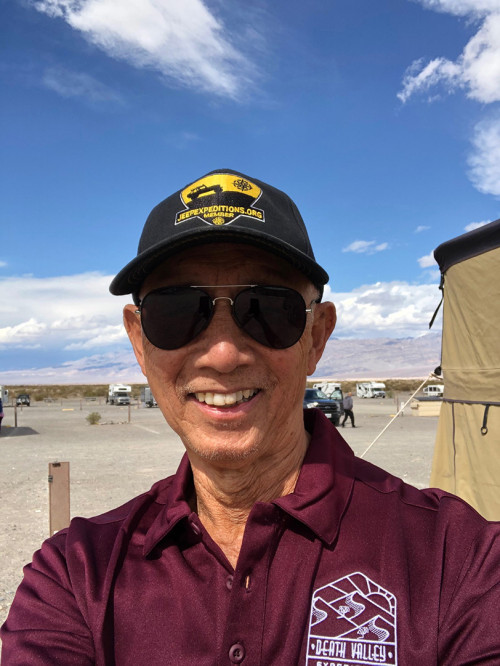
In 2005, Russ needed a new car and decided to buy a Jeep Wrangler. That began a deep dive and journey into online Jeep groups, the California Four Wheel Drive Association, attending Association events in state parks and national forests, taking day runs on easy, moderate, and extreme trails and participating in several jeep clubs. He enjoys trail runs in Arizona and California and has equipped his Wrangler with many modifications including big tires, drive shaft modification, special axels, GMRS and ham radios, GPS, and skid plates required for the extreme trails. He loves to camp with other Jeep members in the back country. His favorite runs are to the San Juan Mountains in Southwest Colorado, Moab, Utah, Big Bear Lake, CA, the Salton Sea, and Death Valley Deserts in California. Eight years ago, he served as the State Treasurer for the California Four Wheel Drive Association for three years and a year ago became the Vice President of the Southern California District. Russ loves to say that “Members of the club often come to me asking for maintenance advice because they think I know a lot!”
Russ thought carefully about suggesting the following Life Lessons Learned:
- Vision. A leader must have a vision of want he wants to accomplish and how he wants things to happen.
- Share Your Vision. Subordinates need to know and understand your vision to buy in and work with you.
- Supervise and Delegate. Follow up to ensure that your vision is executed.